



|
|
|
 
  |
From Lombok to Kumai
And the last email ended….
“Our last evening in Teluk Narah was spent working on the charts, working out the route, waypoints etc and uploading them into the Nav System.
Then, the next day we headed off – destination Kumai in Kalimantan (or deepest darkest Borneo as it was once known).”
Heading to Kumai
It was a little strange saying goodbye to Eloise and Optimum Trust, but also fulfilling. For the first time we were heading off the beaten track on our own – and that is one of the things we are doing this trip for. We waved goodbye to Tris & Jas of Eloise, called up Tom of OT on the VHF and headed north west.
It was a perfect day to leave – 15-20 knots of wind on a broad reach – Hinewai was flying. As we sailed along the bottom of Gili T, the strong Lombok current created an interesting mass of water – swirling, upswells – a real washing machine, but we swept through it.
Once past, we set our course for Kangean, an
island about 100 nautical miles away, dodging strange
structures en-route. They look like floating haystacks, but
are actually
The plan was to aim for Kangean and stop over on the anchor for a night if we were tired, but we were trucking so headed straight past. It’s an odd bit of water, you’re moving from major deeps of up to 4,000 feet to depths of 2 or 3 hundred with a line of islands marking the boundary. In the passage through the islands, the seas get a bit confusing – we had 2 metre waves coming from the south and 2 metre waves coming from the west – by themselves not bad, but now and again, two waves got together to give 4 metres. Oh, how we rolled over those.
Bawean and Fishing Fleets – and Fish Traps
The next target was the island of Bawean, but first we had two challenges. The first was the fishing fleet – around 1am, we started to see this solid phalanx of blips on the radar – some moving, some apparently stationary. Peter appeared in the cockpit, bleary-eyed for the watch changeover at 3am to find Jean standing rock solid behind the wheel.
“Everything going ok, darling?”
“Don’t look,” was the steely reply. “just take a deep breath as these two rather large fishing trawlers sandwich us between them.” They whizzed past close enough to touch.
As dawn broke, we could see all these sea-going fishing boats - some heading home while others were anchored up in the shallower waters for the day. It was an interesting 12 hours as we threaded our way through them.
Our relief at watching them drop over the
horizon was tempered as we started to get close to Bawean.
From here, the local fishermen head out and set fish traps –
a 20 ft length of bamboo with nets hanging below them.
Fortunately they do mark them with
Happily, and often due to Jean’s eagle eyes, we managed to get through and arrived at Bawean after 3 days, dropping the hook early morning in a quiet little bay.
Within about 30 minutes, one of the local boats came over with three chaps aboard, claiming to be from the local police – well, one was wearing a white boiler suit with a suitable impressive crest on it (but spoiled a little bit by the name of a shipping company on the back). Greetings were swapped and they invited themselves aboard, with our permission, producing an official looking document and telling us we had to pay them Rp 200,000 to anchor here.
Peter popped down below and came up with our CAIT (the yacht’s visa), saying that we had been told by the Indonesian government that this was all we needed, and that we should not pay anyone any more money. Now the CAIT is an impressive document, covered in official stamps, and nothing happens in Indonesia unless you have stamp.
All of a sudden, the tone changed and Rafe,
the boiler suited one, quietly put his document away and
changed the subject. They were actually nice people, Rafe,
his son and cousin, and we chatted away for an hour or so.
He’d been a seaman and had travelled the world and it was
interesting listening to his view of where he had been. We
drank a few Cokes together, gave them a pack of smokes and
they left good friends, knowing we knew we’d called their
bluff.
We only spent under 24 hours in Bawean, just time for a catch up on sleep. In hindsight, it was a shame we didn’t stay longer since a couple of yachts following us spent a few days there, and told us the locals were some of the nicest they’d met in Indonesia. But we were Kumai bound.
As before, the first 12 hours were a little hair-razing, dodging fish traps, but they peter out once you get further than the locals can get out to check them in a day. It was good sail up towards the Kumai river mouth, indeed, too good arriving in the early hours. We never get too close to hard lumpy land at night so ended up heaving to for 6 hours, although Peter had a major scare when a tug and its tow got a lot closer than he intended.
Up to Kumai and meeting Herry
While we found the Kumai River wide and deep,
the entrance is narrow and
Kumai was a real eye-opener – this long port
town 10 miles up a river –
Once secure, Herry came on board and we sat and chatted over a Coke or two. He’s a youngster, mid-30’s maybe, but warm and helpful. He told us we were early and the first yacht to arrive this season so he wasn’t quite ready yet. He also sadly told us how his daughter, two sisters and his nephew had recently been killed in a bus crash – and since his sisters used to help him, he was a little limited in what he could offer. We so felt for him, he was so close to bursting into tears as he told us.
The next morning we leapt into the dinghy and motored across the river to Herry’s place – easily found with its bright yellow roof. Only to find Rian, Herry’s younger sister, but no Herry. Rian explained that Herry’s wife has just been knocked off her moped and he had rushed down to the hospital she’d been taken to. Talk about it never raining, but pouring….
But for a youngster, Rian was a star, taking us under her wing. We sat and talked for a bit about hiring a klotok, one of the local slow boats with a few crew and a cook, to get up the river to see the orangutans. Once all seemed (note, seemed) sorted, she asked if we’d like to go for a wander around the town with her. That seemed a grand idea.
We’d noticed a local boat building yard as we
came in, with a magnificent wooden ocean going fishing boat
being built, so we said we’d love to have a look there.
Half way there, Jean had to buy an umbrella
just to
But it was worth the walk – what a place – this huge wooden ship on the slips with a mixture of modern tools (chainsaws, planers, big drills) lying around with old adz, chisels etc. And being built in teak! We chatted with the builders – each plank cost them maybe 10 cents - in Oz, each plank would cost $30+.
We took a slightly different route back,
walking through a “residential area”. In our eyes, it all
looks incredibly poor, but everyone looked so happy,
especially all the kids playing out in the street. No TV,
PC’s or Gameboys here – and
And we saw the swiftlet houses. We could see
these large 3 or 4 story grey buildings from the boat –
towering over the single storey town of Kumai.
Visiting a school, hospital, internet café and supermarket
The next day, we headed into the local big town, Pangkalan Bun, with Rian who had invited us to her school. We arrived in time for School Assembly with the students.
In some ways, it was very different to our old schools – the students sat on the floor on rugs, girls at the front, boys at the back, and the staff sat on rugs on a raised stage. And you left your shoes outside. But apart from that, we could have been at any school in Aus, England or Zim. All the girls were well dressed but the boys showed degrees of rebellion with that certain scruffy look. There was a buzz of conversation until the Headmaster stood and spoke, but he still had to call on a couple of boys to quieten down.
After the Head finished, a guest speaker, an Imam, spoke. While we had no idea what he was talking about, he was a great orator, using his voice to hold the room enthralled. When we left, we thanked him and through Rian explained that we had not understood a word, but it sounded beautiful. He seemed delighted – and afterwards Rian explained he had been talking about the role of women in Moslem Indonesian society, how they should be able to take a position that contributes through work and study, not just in the home, and how the men should respect this. He had held the boys’ attention so hopefully his message was getting through.
Rian then said that Herry wanted to meet up with us, so we headed on to the hospital. We assumed that we’d just meet over a coffee, but no, he took us down to the small ward and introduced us to his wife, laying abed and looking very sore. Apparently another moped had just turned in front of her, bringing her and a couple of other bikes down. She was sporting a huge bruise on her face where the strap on her helmet had snapped and pulled the helmet up, but she was lucky – helmets are not often worn. The concern was that she had landed on a handlebar and that there might be some internal injuries (thankfully, all the tests showed she was Ok and she was released a couple of days later).
It was a little odd to be there, got even odder when a stray cat wandered into the room, but she seemed touched that we had taken the trouble to come. As we walked back, Herry assured us all was sorted for our trip, and that the diesel and water we’d ordered was coming soon.
From the hospital, we headed to an Internet
café to check emails (so so slow),
Where we discovered that there was no klotok to take us up river. It had broken down and while all the tour companies help each other out, there were no other spares. It was a disappointment, but we negotiated a compromise – we would have to go in one of the fast speedboats which would actually give us more time with the orangutans, and, since we wouldn’t be able to sleep on a klotok, Herry’s company would pay for us to stay at the Rimba Lodge, an eco-tourism resort. The magic words of air-con and showers sealed the deal.
We headed out to do a little bit of shopping
and got caught up in a procession by all the
Back on Hinewai we packed a few things and spent the evening watching torrential rain come down and large rafts of palms drift past on the river. At 8.00am, the speedboat arrived to pick us up.
Off to meet the relatives
And again we were very fortunate. In
addition to the young driver, we had
Our first stop was Camp Leaky, about 90
minutes up river. It was set up by Biruté Galdikas back in
the 70’s and is the premier research station on orangutans
in the wild. Galdikas is one of the Leaky girls (the others
being the late Dianne Fossey who studied gorillas and Jane
Goodall with chimpanzees) who were inspired and assisted by
the work of anthropologist Louis Leaky.
The camp is a loose collection of huts, reached by a long boardwalk from the river. And we soon bumped into our first orangutan, Sampson. He had been the top male, but last year was usurped in that role by Tom, a younger, stronger male. In the wild he would have become a solitary animal and would probably not have lasted too long, but he had adopted the camp as a new home, albeit disappearing if Tom appeared.
In addition to Tom, there were about another
half dozen orangutans who predominately live in or close to
the camp, all females and all with one or two youngsters.
The good thing about the fast boat was that we reached the camp an hour or so before the tourists in the slow klotoks so had time to just sit and chat with the camp staff as we watched the animals.
All too soon, tourists arrived and the orangutans were lost behind happy snappers so we retired to the shade of a big tree and sat with the staff. A couple of hours later, everyone headed off into the jungle to a feeding station.
These are simply big wooden platforms where extra food and nutritional supplements are put out for the wild apes. They don’t really need it and tend to treat it like a treat – some days they may pop down for a feed, other days they won’t bother.
But what strikes you is how they move through the trees. These are big heavy animals and they use their weight to travel. They’ll grab the top of a thin tree and let it bend down until they can reach the next tree. When they let the first tree go, it slings back upright with a huge rustling - you can hear them from miles off.
Once the feeding was done, we stayed a while and just watched. Some left quickly, but others, especially the females, hunkered down up the trees and kept a weather eye on their youngsters scampering around.
Click here for more pictures of the orang-utans
After dinner, we sat in the library and read through a few books on the orangutans. Their DNA is closer to us than it is to the other great apes, and they are considered the most intelligent. A lovely quote from a Perth zoo keeper (Perth Zoo is recognized as having one the best care and breeding programs for orangutans in the world) struck a chord:
Give a chimp a screwdriver, and he’ll just throw it at another chimp Give a gorilla a screwdriver, and he will use it to scratch himself Give an orangutan a screwdriver, and he will use it to escape
The next morning we were off early to Camp Leaky where again we just sat quietly with the staff – just watching half a dozen orangutans passing the time of day.
And then a truly special moment. One of the mothers came over to Peter, who was sitting on some steps, and just held his hand. She felt dry and warm, and was so so gentle, her youngest hanging on to her, mouth on nipple and fast asleep.
We sat there and watched her adolescent son
playing with Sampson who was pretending he had noticed the
youngster creeping up on him. The little one would pounce
and he and Sampson would mock fight, rolling around in the
dust, before chasing off into the bush and up and down
trees. After a bit, Sampson would come back, settle himself
down and the game would start again. Sampson is so
And in the trees above us, the two gibbons sprawled across a branch, lazily grooming each other, and a cat slept in the sun beside us.
Three hours passed so gently, seeming to last for ever, but were then gone in a flash as other tourists arrived. Sadly, we said goodbye to our hairy ginger friends and headed off, spotting Sampson sitting in one of the water cisterns. He’d found or stolen a bar of soap and was having a fine old time.
From Leaky we headed to Pondok Tangguy, another smaller orangutan rehabilitation centre down river.
Up to a few years ago, young orangutans who had been taken into captivity as pets were rehabilitated at Leaky and a couple of other camps locally and released back into the wild. The researchers at Leaky noticed however that this was causing some stress within the indigenous local orangutan population and the process was moved to other areas without major local orangutan populations.
While Leaky is still the research centre, this has left Pondok Tangguy and Tanjung Harapan without their main reason for being. However, they are still maintained as outposts and feeding stations because their presence is a deterrent to the illegal loggers who would quite happily clear fell the forest sounding them.
They too have feeding platforms and we stopped at each to watch. In both cases, there were only four or five orangutans who turned up, and at Tanjung Harapan, we were the food for thousand s of feral mosquitoes that descended on us in a black cloud.
Then, as dusk fell, we headed back to Hinewai (after waiting for an hour or so for some klotoks to clear a big floating pad of lilies blocking the river) and spent the evening looking through the photographs and trying to relive the moments.
These are truly wonderful animals, endowed with not only great strength but also poise and gentleness. They are truly sentient beings, totally aware and capable of thought with their great intelligence. Yet we are killing them. The illegal logging, undertaken with the illicit blessing of the Indonesian Government, is destroying their habitat – leaving small groups isolated and so unable to sustainabley breed with other groups.
We should be ashamed if we buy a piece of teak garden furniture or anything made with Indonesian wood. Odds are that when that tree was young, it was bent by the weight of an orangutan as it traveled through the forest – a forest that is now gone leaving only a moonscape behind.
Someone said “The eyes are the gateway to the soul”. This is so true for the wonderful creatures, but they are more. Their presence is the gateway to their souls, and we had been fortunate enough to catch a glimpse through that gateway.
Signing out from Indonesia
The next day was back to reality – even worse, Indonesian bureaucracy, a Dali-sequel blend of “job’s worth” and rubber stamps.
When you enter or leave a country on a yacht, there are certain formalities to go through. When we arrived in Bali, it wasn’t too bad since we had an Agent to facilitate everything, but in Kumai, we were going to have to do it ourselves. But not quite alone, Ifung, who we met through Rian, offered to come along and help.
First stop is immigration, over in Pangkalan Bun. We flagged down a local taxi and squeezed in for the 30 minute drive. The Immigration department is a stately single storey building with a large tiled office area. Two desks and a table tennis table.
We sat across the desk from the Immigration Officer and pulled out the four copies of our passports, crew-list, registration papers and any other document we could think off. And, of course, the all-important Ship’s Rubber Stamp – without which nothing would get done.
It was all relatively painless, the guy was really nice, and with various bits of paper and our passports stamped, and stamped, and stamped, and stamped, and having only had to pay a very reasonable “fee” of Rp100,000, we headed on to Customs. “Only short walk of 1km” our Agent assured us. Dripping with perspiration, aching feet and thirsty throats, we limped into Customs, a mere 3/4kms later.
Here, as the first yacht of the season, we were looked after by one of the senior Customs Officers, who chatted away with us as a junior ran around get the paperwork done (and stamped) ready for his bosses signature. There was a small discussion about the merit of Scotch Whiskey, but since we don’t carry any, even as gifts, it went nowhere.
Then to our surprise, the Senior Officer offered to run us back to Kumai. We accepted gratefully, an air-con'ed official car is far better than a local taxi. After a quick stop in his boss’s office, he drove us back to the Harbour Masters in Kumai, and wouldn’t accept a penny.
At the Harbour Masters, again there was a severe outbreak of forms to be completed and stamped. While Peter was doing this, Jean got chatting with one of the young officers, trying to track down a more detailed up-to-date weather forecast, but with no joy.
Getting back to Herry’s office, we weren’t
surprised that there was still no fuel or water, but they
promised it would be there by 4pm. We headed back to
Hinewai to get ready to head off the next day, only to see
Tom and Rambo coming up the river and anchoring behind us.
Tom popped over in his dinghy and we caught up on each
others news over a Rum & Coke or two.
At 4, Peter took our dinghy over and, to his surprise, about half the fuel and water was there. It turned into a ferry evening – take what was available, decant it into the appropriate tanks and bring the empties to be refilled, but at last we had a pretty full load. So we lifted the outboard on board and tied it off before deflating and stowing the dinghy.
That night, we had the heaviest storm we had seen in Kumai – not just heavy rain, but strong winds. It didn’t look too good to think about leaving so Tom gave Jean a lift back to shore for her to revisit the Harbour Master’s to see if they had any new weather. Their internet was still down, but they got round the problem by calling up one of the ships alongside who downloaded a forecast out of Singapore – and it didn’t look great. The Harbour Master himself took Jean to one side, shaking his finger side to side as he said “You no go today. Too much wind, big seas. Very dangerous. Maybe OK in 2days, you check again tomorrow.”
One last extra day in Kumai – and departing
So we ended up spending the day with Tom and
popped back into Pangkalan Bun. We wandered around the
shops, had lunch in a local café (leave behind food hygiene
laws all ye who enter here) and Peter got himself a hair
cut.
Back in Kumai that evening, it was still
pouring with rain – not fun to motor across the river in the
dinghy – so we grabbed a last meal of Nasi Goring at a
little café we’d eaten at a couple of times before. Those
meals had been great, sadly this time the cook went a bit
overboard on the chili – and we discovered that sweet red
Fanta is great for cooling the mouth.
Even though the weather still didn’t look great the next morning, we decided to head off anyway – even if we only got as far as the river mouth, there was a nice protected anchorage we could nip into. But the weather was clearing as we motored downstream so we stuck our nose out to find that even though the seas were still reasonably big, the wind had dropped out and was perfect. So we headed on.
It took us eight days and nights to reach our destination – Miri in Sarawak – but more of that next time. Slowly but surely catching up with our tales.
All the best
P & J
Next Log Page: Miri, Labuan, Brunei, races and Kuching
|
|

|
|
|
|
The Crew The Route The Yacht The Log Guestbook Links Contact Us |
|
|
|
|
|
Home |
|
|
All Original Content of this Web Site Copyright © 2000, 2001, 2002, 2003, 2004, 2005, 2006, 2007, 2008, 2009 Ocean Odyssey Pty Ltd |
 fish traps, with big nets hanging below them – the hay stack
look is the hut the fisherman lives in – with depths of over
2,000 feet, there is no way they can anchor so just drift
along, meeting up with “mother boats” every day or so to
transfer the catch or be towed back to their starting
points.
fish traps, with big nets hanging below them – the hay stack
look is the hut the fisherman lives in – with depths of over
2,000 feet, there is no way they can anchor so just drift
along, meeting up with “mother boats” every day or so to
transfer the catch or be towed back to their starting
points.  a bit of wood that sticks a few feet up – and if they are
feeling kind, they hang a bit of sack, or a bucket or an old
t-shirt off it. Hard to spot in the day, a nightmare at
night since if you ran over one, it would wrap the net
around the propeller (later we found traps with no sticks –
prayer came in at this point and seemed to work since we
didn’t hit any).
a bit of wood that sticks a few feet up – and if they are
feeling kind, they hang a bit of sack, or a bucket or an old
t-shirt off it. Hard to spot in the day, a nightmare at
night since if you ran over one, it would wrap the net
around the propeller (later we found traps with no sticks –
prayer came in at this point and seemed to work since we
didn’t hit any).

 convoluted, lots of sand bars and narrow
 channels. Fortunately we had a list of waypoints to use,
and once we’d let a big ship and a ferry out, worked our way
up the river. The electronic charts on the chart plotter
cannot be trusted – at times, it showed us ploughing through
the jungle. Jean called ahead and got hold of Herry of
Herry’s Yacht Services and he came out in a little speed
boat to meet us and show us where to anchor.
channels. Fortunately we had a list of waypoints to use,
and once we’d let a big ship and a ferry out, worked our way
up the river. The electronic charts on the chart plotter
cannot be trusted – at times, it showed us ploughing through
the jungle. Jean called ahead and got hold of Herry of
Herry’s Yacht Services and he came out in a little speed
boat to meet us and show us where to anchor. with sizable local coasters anchored mid-stream or against
the dock. Herry moved us down from where we first anchored
warning us that if we went too far upstream we’d be where
the tugs and their huge barges turn.
with sizable local coasters anchored mid-stream or against
the dock. Herry moved us down from where we first anchored
warning us that if we went too far upstream we’d be where
the tugs and their huge barges turn.

 Big
mistake – she took us there – it was about a 3 mile walk -
in 35C+ and 90% humidity.
Big
mistake – she took us there – it was about a 3 mile walk -
in 35C+ and 90% humidity. 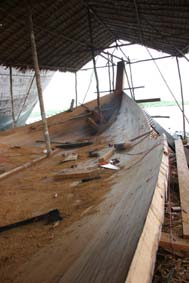 keep
the sun off her – a gloriously tasteful yellow thing it is.
keep
the sun off her – a gloriously tasteful yellow thing it is. parents are not scared like Westerners parents now seem to
be and let their kids go out and get dirty playing. From
everywhere there were calls of “hello mister/hello missus”
and big beaming smiles when you acknowledge them.
parents are not scared like Westerners parents now seem to
be and let their kids go out and get dirty playing. From
everywhere there were calls of “hello mister/hello missus”
and big beaming smiles when you acknowledge them. As
we walked past one place, we could see someone packaging up
bags of biscuits. Rian explained that this was a Kumai
specialty, a sort of shortbread made with fish. She took
Jean inside, leaving Peter chatting with a couple of chaps
on the veranda. Suddenly, there are gales of women’s
laughter coming from the back of the house – us blokes just
looked at each other – a look of “Oh, what are the women up
to now” that transcends language. It turned out, Jean had
brought her camera out and all the ladies were vying to be
best in picture.
As
we walked past one place, we could see someone packaging up
bags of biscuits. Rian explained that this was a Kumai
specialty, a sort of shortbread made with fish. She took
Jean inside, leaving Peter chatting with a couple of chaps
on the veranda. Suddenly, there are gales of women’s
laughter coming from the back of the house – us blokes just
looked at each other – a look of “Oh, what are the women up
to now” that transcends language. It turned out, Jean had
brought her camera out and all the ladies were vying to be
best in picture.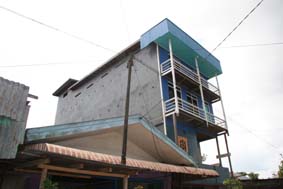
 Up close, we realized they were dummy buildings, sometimes
with false facades to make them look like a house, with
heaps of holes down their sides. Rian explained they were
built to house the local swiftlets – yes, small birds –
because their presence is considered lucky for the town.
They also love sitting on all the wind instruments and
aerials at the top of the mast, but they are so small, they
do no harm.
Up close, we realized they were dummy buildings, sometimes
with false facades to make them look like a house, with
heaps of holes down their sides. Rian explained they were
built to house the local swiftlets – yes, small birds –
because their presence is considered lucky for the town.
They also love sitting on all the wind instruments and
aerials at the top of the mast, but they are so small, they
do no harm.
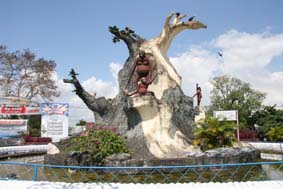 hit
the supermarket and grabbed some lunch with Rian and the
driver before heading back - past a strange roundabout
decoration.
hit
the supermarket and grabbed some lunch with Rian and the
driver before heading back - past a strange roundabout
decoration.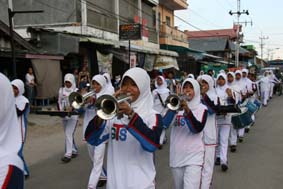 schools
in the area – it was one of the events for the forthcoming
Indonesian Independence Day. We followed along to a local
stadium, where there was a Village Fete event occurring
schools
in the area – it was one of the events for the forthcoming
Indonesian Independence Day. We followed along to a local
stadium, where there was a Village Fete event occurring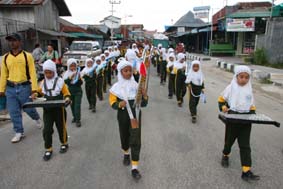 – lots of stalls, a five aside football compet-ition and a
tug of war. Then, argh, we were spotted by the dignitaries
up on the stage and were called up to say a few words. In
our case, very few. Sadly, it looked as if it were about to
pour with rain and we needed to get back to the boat so we
made our apologies and headed back through the crowd, being
greeted by many as if we were long lost friends.
– lots of stalls, a five aside football compet-ition and a
tug of war. Then, argh, we were spotted by the dignitaries
up on the stage and were called up to say a few words. In
our case, very few. Sadly, it looked as if it were about to
pour with rain and we needed to get back to the boat so we
made our apologies and headed back through the crowd, being
greeted by many as if we were long lost friends. Yani (
 All
of them were rescued from captivity, but had become so
acclimatized to humans they had failed to really re-adapt to
life in the wild. So they lived in a half-wild, half-camp
state, but were happy and what was good was that their
youngsters tended to move back into the wild when old
enough.
All
of them were rescued from captivity, but had become so
acclimatized to humans they had failed to really re-adapt to
life in the wild. So they lived in a half-wild, half-camp
state, but were happy and what was good was that their
youngsters tended to move back into the wild when old
enough. In
addition to the apes, there was a pair of gibbons who had
moved in and were just hanging around, some big wild pigs
who followed the apes around, eating any scraps and a couple
of cool cats who treated the apes with distain and showed no
fear.
In
addition to the apes, there was a pair of gibbons who had
moved in and were just hanging around, some big wild pigs
who followed the apes around, eating any scraps and a couple
of cool cats who treated the apes with distain and showed no
fear.

 That
day seemed party time with over 20 orangutans arriving; some
grabbing bunches of bananas and heading back into the trees,
some just sitting grazing on the platforms.
That
day seemed party time with over 20 orangutans arriving; some
grabbing bunches of bananas and heading back into the trees,
some just sitting grazing on the platforms. From Leaky we headed off to Rimba Eco Lodge
for the night – a beautiful setting in the forest with a
troop of monkeys who also call it home and work hard at
breaking into rooms. As dusk fell, we wandered down a trail
to a look-out point high in the trees hoping to catch sight
of the proboscis monkeys – no joy there, but so many
stunning butterflies. Then, joy of joys, a long
From Leaky we headed off to Rimba Eco Lodge
for the night – a beautiful setting in the forest with a
troop of monkeys who also call it home and work hard at
breaking into rooms. As dusk fell, we wandered down a trail
to a look-out point high in the trees hoping to catch sight
of the proboscis monkeys – no joy there, but so many
stunning butterflies. Then, joy of joys, a long cold shower
before dinner.
cold shower
before dinner.
 strong
he could have torn the little one into small pieces, but he
was so gentle as they played, letting the little on “thrown”
him around.
strong
he could have torn the little one into small pieces, but he
was so gentle as they played, letting the little on “thrown”
him around.


 It was so sweet, the young girl doing the cutting had
to go and get her high heels on – even with him slumped in
the chair, she couldn’t reach the top of his head.
It was so sweet, the young girl doing the cutting had
to go and get her high heels on – even with him slumped in
the chair, she couldn’t reach the top of his head.